Storm and hazard response
Emergency tree removal in Placerville
An emergency tree is one that cannot wait for a scheduled appointment: a trunk on your roof, a tree across the only way in or out, a limb hung up over a power line, or a leaning tree under tension that could let go at any moment. Call the number on this page and you get connected with a licensed, insured tree service that works El Dorado County and takes these calls around the clock. This page explains what makes a tree an emergency, how a crew takes one down safely, and why storm work is priced and queued the way it is.
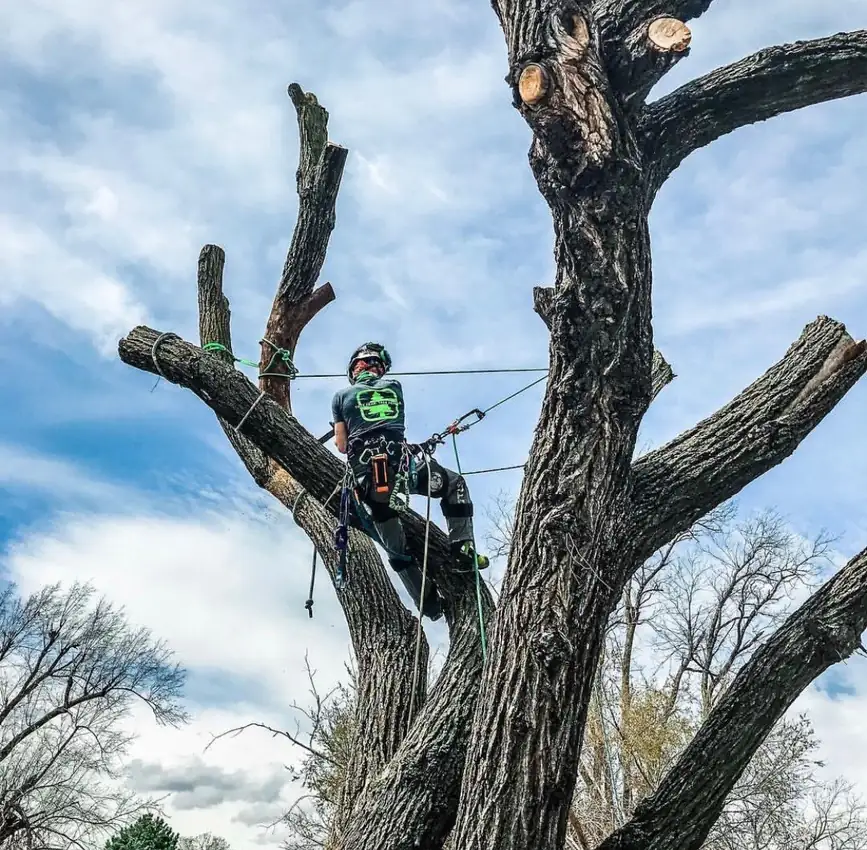
What makes a tree an emergency
A tree already flat on the ground in an open field is a cleanup job. What turns a tree into an emergency is a hazard to people, to a structure, or to access, and there are four situations that qualify almost every time.
A tree on a structure. A trunk or a large limb resting on a roof, a wall, a deck, or a vehicle is loading that structure in a way it was never built for, and every hour it sits there it can shift, settle, or push through. This is the call that moves to the front of the line.
A tree blocking the only access. Out here a lot of homes sit at the end of a single long driveway with no second way out. A tree down across that driveway is not just an inconvenience, it can trap people in or keep an ambulance or a fire engine from getting to the house, which is why it gets treated as urgent even when nothing is damaged yet.
A tree hung up or leaning under tension. A tree that has fallen partway and lodged in another tree, or a trunk that has split and is leaning toward the house, is holding a load. It is a spring waiting to release, and the direction it wants to go is not always obvious. These are the most dangerous trees to work and the worst ones to poke at yourself.
A tree on a power line. This one is a 911 and utility call before it is a tree call. A limb or a whole tree tangled in electric lines is an electrical emergency first, so call 911 and your electric utility, treat every line as live, and stay well back. A private crew cannot touch an energized line and only removes the tree after the utility has cleared it.
Taking down a tree under load, safely
The reason emergency work is a specialist job comes down to load. A healthy tree standing in the open is predictable. A storm-damaged tree is not: the weight is hanging in the wrong places, fibers are already torn, and a trunk can be bent like a drawn bow with all that stored energy pointing somewhere. The first thing a good crew does on arrival is not cut anything. It is read the tree.
Reading a tree under tension means working out where the load is, which fibers are holding it, and which way it will move when they are released. A leaning trunk has a compression side and a tension side, and cutting them in the wrong order makes the trunk snap toward the crew or barber-chair up the stem, which is exactly the accident that hurts people. The crew plans the cuts so the tree comes apart the way they intend, often taking the weight off in small controlled pieces roped down one at a time rather than dropping anything whole. On a tree that is on a house, pieces are frequently lifted away rather than cut and dropped, which is where a bucket truck or a crane comes in. None of this is improvised. It is a sequence, and the sequence is the safety.
This is also why taking a saw to a loaded tree yourself is such a bad idea. A cut that looks obvious can be the one that releases the tension in your direction. If a tree is on your house or hung up over your driveway, the right move is to keep everyone back and let a crew that does this for a living handle the order of operations.
Tree on the house or across the driveway right now? Describe it on the phone and get a crew headed your way.
Storm response and the queue
A single tree down on a calm day gets a fast response. A big winter storm is different, because a storm does not bring down one tree, it brings down dozens across the county in the same few hours, and every one of those homeowners is calling at once. That is why there is a queue in a serious storm, and understanding it helps you get seen sooner.
Crews triage. When the phone is ringing off the hook, the jobs that move up the list are the ones with the most at stake: a tree actively on a house, a tree pinning a car with someone needing to get out, a tree blocking the only road to a home, or anything tangled with power lines that the utility has cleared to work. A tree that is already down in the yard and not threatening anything, however annoying, waits behind the ones that are still doing damage. So when you call, describe the situation plainly and accurately: what the tree is on, whether anyone is trapped, whether it is your only way out, and whether lines are involved. That is the information that decides where you land in the order, and it lets the crew bring the right equipment the first time. Storm season up the hill toward Pollock Pines adds snow load to the wind, so the ridge tends to generate its own wave of calls.
The power line rule
If a tree or a limb is touching a power line, the job stops being a tree job until the utility says otherwise. The rule is simple and it does not bend: treat every line as live, whether it looks energized or not, and keep people, kids, and pets well back from it and from anything metal it might be touching, including wet ground and fences. A downed line can energize the earth around it.
A responsible crew will not start cutting a tree that is in contact with electric lines. They coordinate with the power company, which controls whether and when the line is de-energized, and only then is it safe to remove the tree. This is not a delay anyone invents to pad the job, it is the line between a routine removal and someone getting electrocuted. If your emergency involves a line, call 911 and your electric utility first, keep everyone back, and let the utility make it safe before any crew touches the tree.
Dead pines: the emergency in waiting
Most of the truly dangerous emergency calls in this county are trees that were a known problem long before they failed, and the classic example is the standing dead pine. Years of drought stressed the pines across these foothills, bark beetles moved into the stressed trees, and the result is dead ponderosa and gray pine standing on properties all over El Dorado County, very often right next to a house or a driveway because that is where they were kept.
A dead pine does not get safer with time. It gets more brittle every season, the wood loses its integrity, limbs start dropping on their own, and eventually a wind event or a snow load brings the whole thing down, usually at the worst possible moment. That is what makes it an emergency in waiting. The same tree that would be a straightforward scheduled removal on a dry Tuesday becomes a midnight crisis after it comes through the roof, and it costs far more at that point. The honest advice is to deal with dead pines that can reach something you care about before they pick the moment for you. The tree removal cost page walks through why a dead pine can actually cost more to take down than a living one.
What emergency work costs
Emergency and storm removal carries a premium of roughly 50 to 100 percent over the same tree taken down on a schedule, which commonly puts a serious storm job in the range of $1,500 to $5,000 or more, and higher when a crane or utility coordination is involved. That premium is not gouging. An emergency job happens now, often after dark, frequently in bad weather, and usually under difficult conditions with a tree under load and a structure in the way. The crew is carrying more risk and more difficulty to solve a problem that will not wait, and the price reflects the job rather than the calendar.
A tree that is on a house or needs a crane does not get a flat number on this page, because it depends entirely on access, whether a crane is needed, and whether the power company has to be involved. The way to keep an emergency from turning into an emergency price is to take care of the obvious hazards ahead of time. Get a second opinion on your own trees before storm season and read the defensible space page for how clearing hazards early prevents the after-hours call.
Emergency questions
Is it safe to wait until morning?
It depends on what the tree is doing. A tree already down and not touching anything can usually wait for daylight, and daytime work is safer and often cheaper. A tree on a structure, leaning under tension, or tangled with a power line is a different story, because it can move overnight and get worse. If a power line is involved, call 911 and your electric utility right away. If people are in the path of it or it is loading a roof, do not wait. Get everyone clear and call it in so a crew can advise on the phone.
Can I just cut the tree off my roof myself?
Please do not. A tree resting on a structure is holding a load, and the cut that relieves it can send the trunk through the roof or back at you. Storm-damaged trees are full of stored tension that is hard to read without experience, and a chainsaw on a ladder next to a damaged tree is how serious injuries happen. Keep everyone out from under it and let a crew that reads loaded trees for a living take the weight off in the right order.
Why does an emergency cost more than a regular removal?
Because it is a harder, riskier job done on no notice. The same tree carries a premium of roughly 50 to 100 percent when it has to come down now, after hours, in weather, under load, versus on a dry scheduled day. You are paying for the urgency, the added risk, and often extra equipment like a bucket truck or a crane, not for a different tree.
Will the crew coordinate with the power company for me?
A tree in contact with electric lines is a 911 and utility call first, handled with the power company, not around it. Call 911 and your electric utility, treat every line as live, and keep everyone well back. A responsible tree crew will not cut a tree touching live lines, and cannot until the utility de-energizes and clears it. Only then does the tree removal happen.
Do you handle removals outside the emergency, too?
Yes. The same local crews handle scheduled tree removal, trimming, stump grinding, and defensible-space clearing. Getting the dead and hazard trees dealt with on a schedule is the surest way to avoid ever needing the emergency number. More on the FAQ.
Get connected with a licensed local tree service.